
In recent years, Artificial Intelligence (AI) has become an integral part of technological advancement, revolutionizing industries and reshaping the way we interact with the world. At the heart of AI systems are intelligent agents—entities that perceive their environment and take actions to achieve specific goals. Understanding the different types of AI agents is crucial for businesses and individuals looking to leverage AI capabilities effectively. This article explores the various types of AI agents, providing insights into their functions and applications.
Table of Contents
What are AI Agents?
Artificial Intelligence (AI) agents are the foundation of many intelligent systems which helps them to perceive their environment, make decisions and take actions to achieve specific goals. These agents vary in complexity from simple reflex-based systems to advanced models that learn and adapt over time. You can explore about AI Agents in details by clicking on this [read]
Types of AI Agents
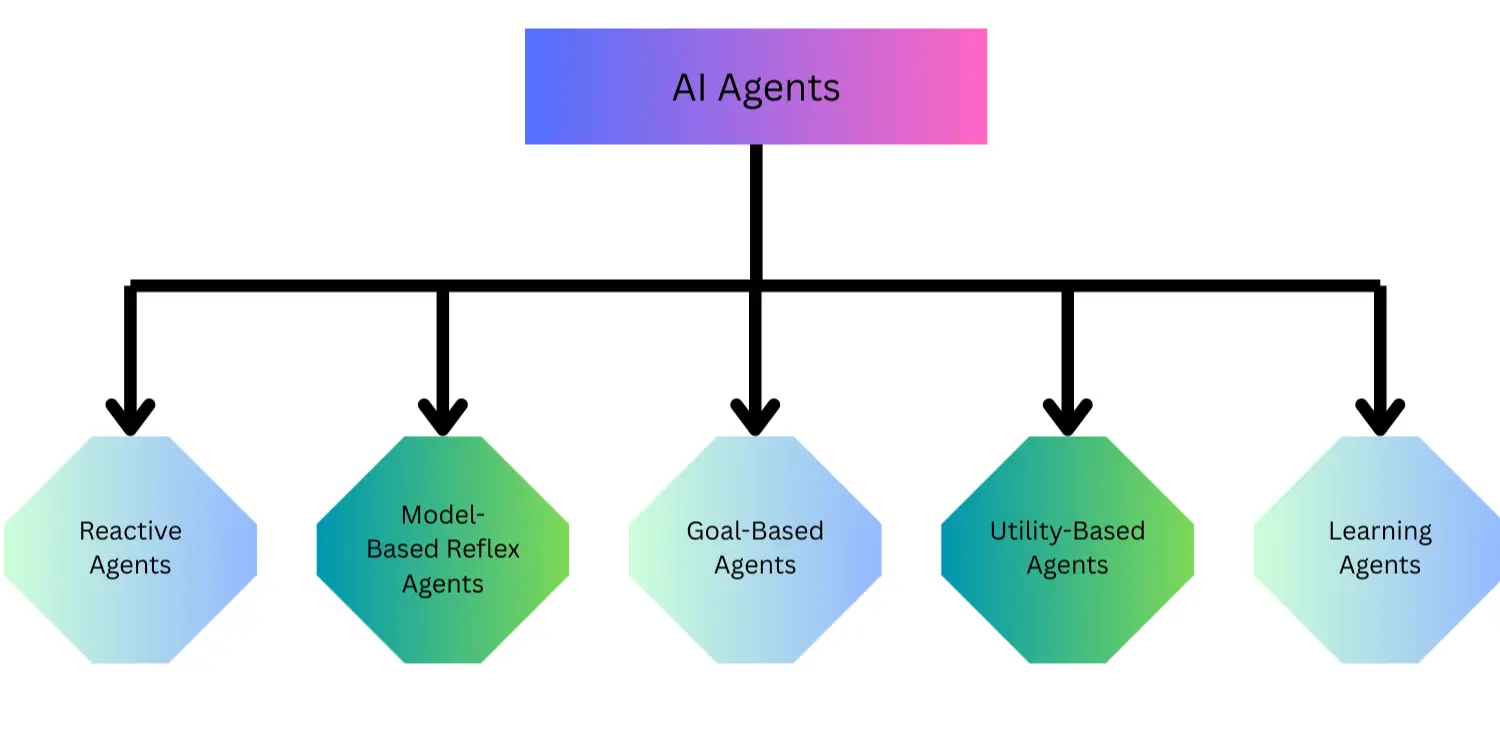
1. Reactive Agents
Reactive agents are the simplest form of AI agents, designed to respond directly to environmental stimuli without maintaining any internal state or history. They operate on a condition-action basis, meaning they react to specific conditions with predetermined actions. Reactive agents are typically used in applications where real-time responses are crucial, such as robotics and simple automated sys
Applications: Reactive agents are ideal for tasks requiring immediate responses, such as obstacle avoidance in robotics, automated trading systems, and thermostat control.
Characteristic:
Simplicity: Reactive agents are straightforward and operate based on predefined condition-action rules.
No Memory: They do not maintain any internal state or history of past actions, focusing solely on current stimuli.
Immediate Response: Designed for real-time interaction, making them ideal for environments requiring quick reactions.
Limited Flexibility: Due to their lack of internal state, they are less adaptable to changes in complex environments.
2. Model-Based Reflex Agents
It take the concept of a simple reflex agent a step further by introducing an internal model of the environment. This model allows the agent to store information about the world making it more capable of dealing with partial observability where the agent does not have access to the full state of the environment at all times.
Applications: Consider a self-driving car. It reacts to road conditions but it also maintains an internal model that includes information like traffic laws, previous traffic patterns and maps. This allows the car to make better navigation decisions such as planning alternate routes when there’s a traffic jam.
Characteristics:
Internal State: They maintain a model of the world, which helps them predict future states and make informed decisions.
Improved Decision-Making: The model allows for better handling of uncertainty and complexity compared to reactive agents.
Condition-Action Rules: They still rely on rules, but with the added benefit of an internal model for context.
Environment Representation: Their ability to represent the environment internally enables more sophisticated responses.
3. Goal-Based Agents
Goal-based agents are designed to pursue specific goals, allowing them to make decisions based on a set of objectives rather than predefined condition-action rules. These agents evaluate different actions and select the ones most likely to achieve their goals. They require a search and planning mechanism to determine the best course of action.
Applications: Goal-based agents are suitable for applications such as game playing (e.g., chess or Go), where the agent must evaluate possible moves to achieve victory. They are also used in automated planning and scheduling systems.
Characteristics:
Goal-Oriented: These agents focus on achieving specific objectives rather than following predefined rules.
Decision Evaluation: They assess different actions based on their potential to achieve the desired goal.
Search and Planning: Equipped with mechanisms to search for and plan the best course of action.
Flexibility: More adaptable to changes in goals and environments, allowing for dynamic decision-making.
4. Utility-Based Agents
Utility-based agents go a step further by using a utility function to evaluate the desirability of different states. Instead of pursuing a single goal, these agents aim to maximize overall satisfaction or utility, balancing various competing objectives. This approach allows for more nuanced decision-making, especially in complex environments where trade-offs are necessary.
Applications: Utility-based agents are used in economic modeling, where agents must make decisions based on maximizing profit or utility while considering multiple factors such as cost, risk, and reward.
Characteristics:
Utility Function: They use a utility function to evaluate the desirability of different states, aiming to maximize overall satisfaction.
Trade-Off Management: Capable of balancing multiple objectives, making them suitable for complex decision-making scenarios.
Optimal Decisions: Focused on achieving the highest utility across competing goals.
Sophisticated Evaluation: Their ability to weigh different factors leads to nuanced and optimized decisions.
5. Learning Agents
Learning agents are capable of improving their performance over time through experience. These agents have the ability to learn from their interactions with the environment, adapting their strategies and behaviors to achieve better results. Learning agents consist of four components: a learning element, a performance element, a critic, and a problem generator.
Applications: Learning agents are prevalent in machine learning applications, including recommendation systems, autonomous vehicles, and personalized assistants. They are essential in environments where adaptation and improvement are critical.
Characteristics:
Adaptive Learning: Capable of improving their performance over time by learning from interactions with the environment.
Experience-Based Improvement: These agents evolve and refine their strategies based on past experiences.
Components: Consist of a learning element, performance element, critic, and problem generator, each playing a role in the learning process.
Dynamic Adaptation: Highly adaptable to changing environments, allowing them to respond to new challenges effectively.
Each type of AI agent is designed with specific characteristics that make them suitable for particular tasks and environments. Reactive agents excel in simple, real-time applications, while model-based reflex agents are better suited for situations requiring context awareness. Goal-based and utility-based agents provide more sophisticated decision-making capabilities for complex scenarios, and learning agents offer the adaptability needed for dynamic and evolving environments. Understanding these characteristics allows for informed selection and deployment of AI agents in various technological applications.
Conclusion
The diverse types of AI agents offer unique capabilities suited to various applications across industries. From simple reactive agents to complex learning agents, understanding the strengths and limitations of each type is crucial for selecting the right AI solution for specific needs. As AI continues to evolve, the development and deployment of intelligent agents will play an increasingly vital role in driving innovation and efficiency.
Businesses and individuals looking to harness AI capabilities must consider the specific requirements of their applications and choose the appropriate type of agent to ensure optimal performance and outcomes. Whether it’s real-time responsiveness, goal-oriented planning, utility maximization, or adaptive learning, AI agents provide the foundation for intelligent systems that can transform the way we interact with technology and the world.
weed gummies for anxiety relief calm